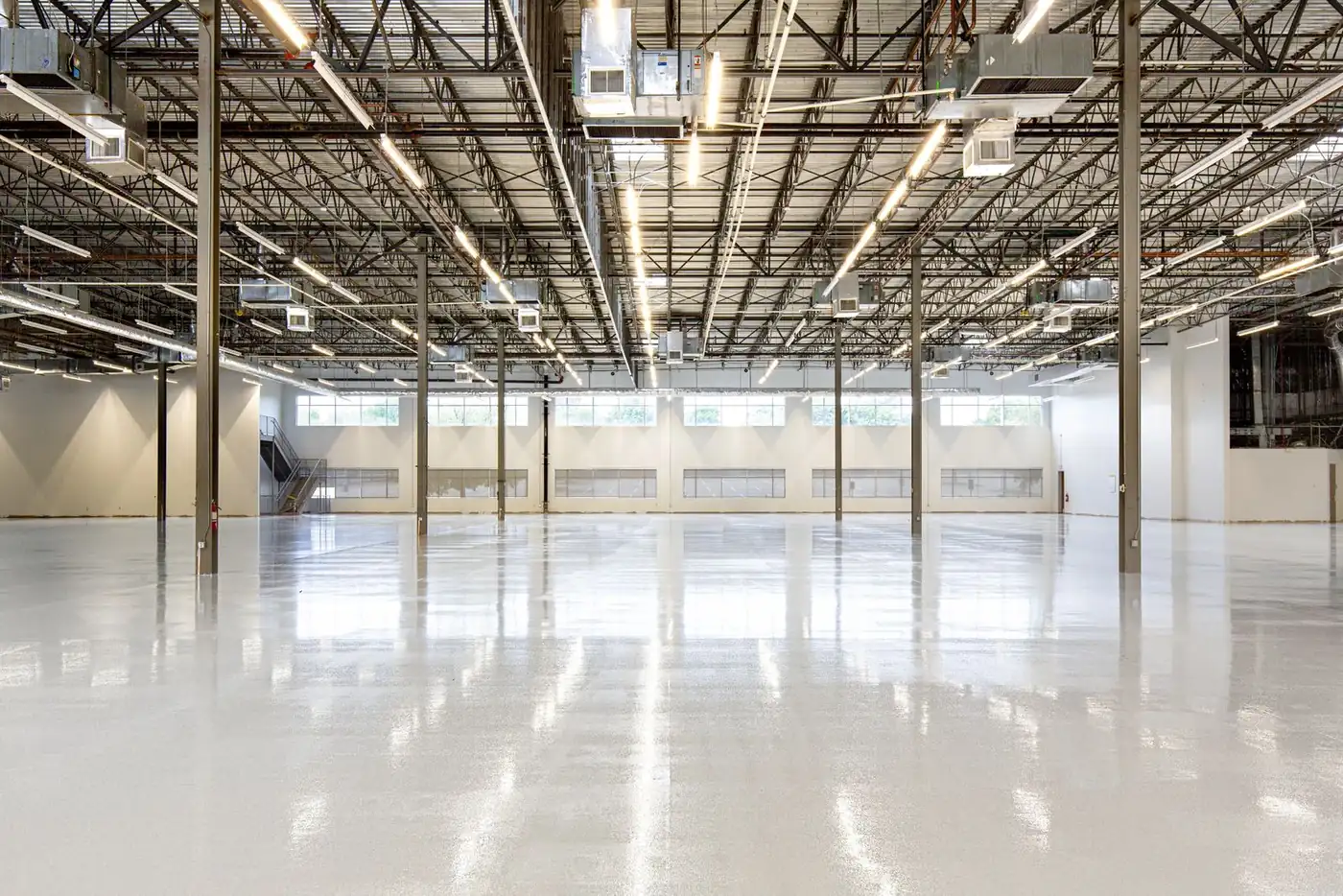
High-build coatings for warehouses, shops and light industrial floors — phased so your operation keeps running.
Call Now for a Free EstimateTell us about the floor and we’ll get back to you the same working day.
Prefer to talk? Call (209) 444-2506
Commercial epoxy flooring in Stockton covers the shop, warehouse and light industrial floors that have to keep working while people and equipment run over them all day. We coat spaces around the Port of Stockton, the Arch Road corridor, Airport Way and the shops along Wilson Way, and we schedule the work in phases or on weekends so the operation does not stop.
The prep is the same idea as a garage, at a different scale. Ride-on and walk-behind grinders with dust containment open the slab to a CSP 1 to 2 profile. Joints get cleaned and filled with a semi-rigid filler so forklift wheels stop chipping the edges, and spalled areas get rebuilt.
Commercial systems are built thicker than residential ones. A high-build epoxy carries the impact and abrasion of pallet jacks and forklifts, and where the floor sees chemicals or wash-down we specify a resin rated for it. Anti-slip aggregate gets broadcast into the topcoat anywhere water shows up — wash bays, entries, dock aprons.
Line striping, aisle marking and safety-color zones go in before the final clear coat so they wear with the floor instead of off it.
Load and volume. A residential garage sees one or two vehicles parked on a coating; a warehouse floor takes point loads from loaded pallet jacks, hard forklift wheels, dropped freight and constant turning — the twisting motion is what tears at a thin coating.
The second reason is that commercial slabs are far more likely to be machine-troweled, which leaves a weak layer of cement paste sitting on the surface. Acid etching barely touches it. Coat over that layer and the floor delaminates in traffic lanes first, because that is where the shear is highest.
Moisture is the third. Large slabs poured on grade in the Central Valley move vapor upward, and a coating with no vapor tolerance traps it. The result is bubbling and disbonding in patches that look random but are not.
Commercial floors are quoted after a free site walk. The variables below shape the scope as much as the size does.
| Factor | Effect on your quote |
|---|---|
| Coating thickness | Forklift traffic calls for a high-build system rather than a thin-mil coating |
| Joint and crack work | Filling and rebuilding joints across a warehouse is a significant line on its own |
| Downtime constraints | Night and weekend phasing to keep you running adds labor hours |
| Chemical exposure | Areas with solvents or acids need resins rated for them |
| Markings | Line striping, aisles and safety zones are scoped by length |
Polished concrete is the existing slab mechanically ground and densified — no coating on top. Nothing can delaminate because there is nothing added, it handles moisture vapor without complaint, and it is the lower-maintenance option long term. It cannot give you color, chemical resistance, or a sealed non-porous surface.
Epoxy gives you all three. It seals the concrete against oil and chemicals, comes in any color with markings built in, and can be built thick enough to level a rough floor. It also depends completely on the bond, which means prep and moisture testing are not optional.
Rough guide: a food, pharma or chemical environment that must be sealed and cleanable wants epoxy. A dry warehouse or showroom where the concrete is already sound often does better with polish. If the slab is pushing moisture, that pushes the decision toward polish or toward epoxy over a vapor-barrier primer.
Smaller shop floor? The residential garage epoxy system covers most single-bay spaces.
Yes. Commercial work is normally phased section by section, or run over nights and weekends, so one area cures while you keep operating in the rest. We map the phasing with you before the quote so the schedule is part of the number, not a surprise later.
Light foot traffic is usually fine the next day. Full forklift and pallet jack traffic should wait for the resin to reach hardness, which is roughly five to seven days for a standard epoxy system. Faster-curing topcoats can shorten that when downtime is the binding constraint.
A high-build system does, provided the slab was ground properly first. Failures in traffic lanes almost always trace back to prep: a machine-troweled slab leaves a weak layer of cement paste on the surface, and the twisting load of a turning forklift shears the coating right off it.
Yes. Aisles, safety zones and equipment markings go down before the final clear coat, so they are sealed under it and wear with the floor rather than off the top of it. They are laid out with you during the site walk and included in the written estimate.
We measure the slab, test how it takes water, and hand you a free written estimate before we leave. No obligation.