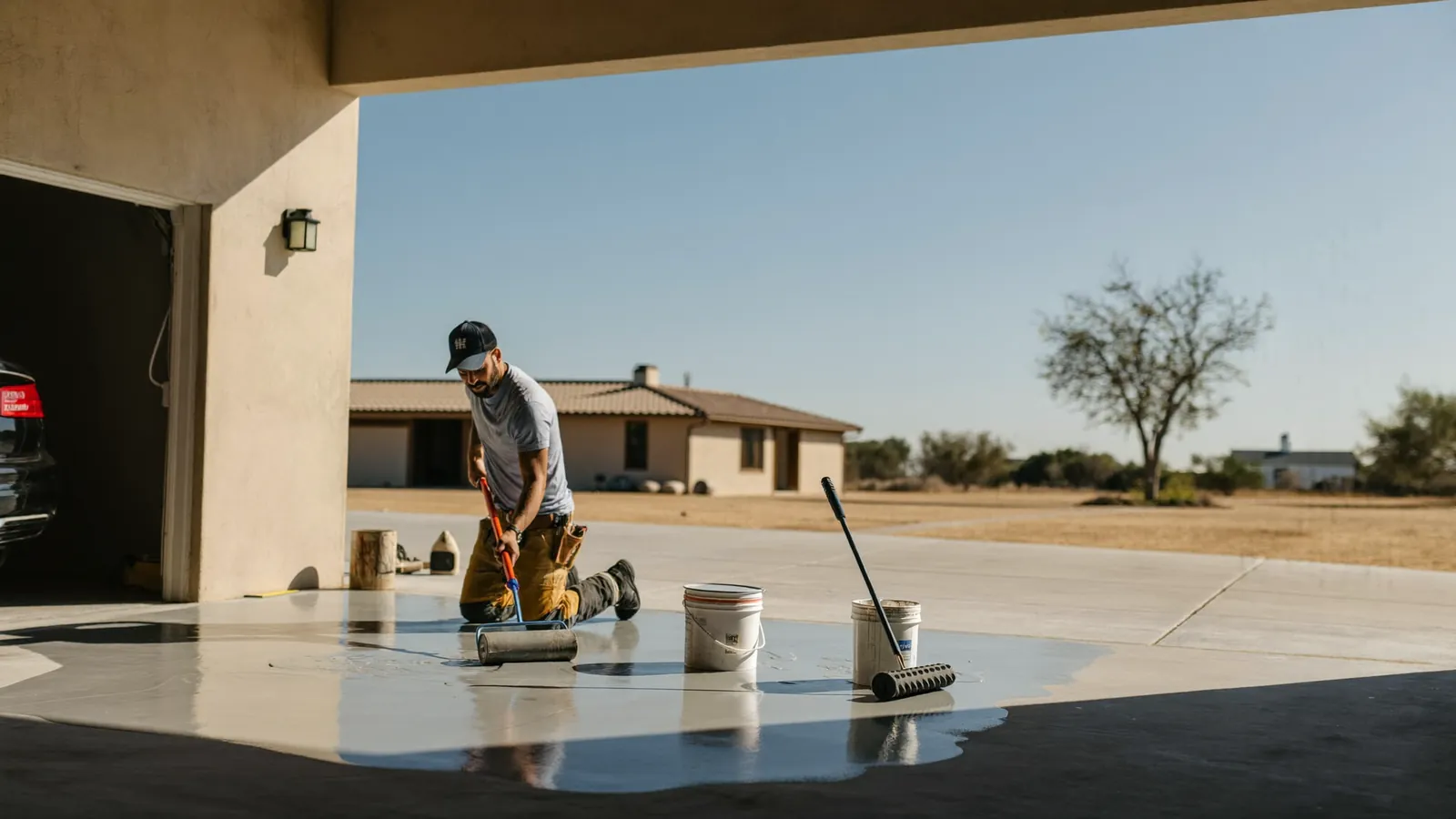
Garage floors, shop floors and patios coated with a system that survives 100-degree Central Valley summers — ground down to bare concrete first, so it actually sticks.
Call Now for a Free EstimateTell us about the floor and we’ll get back to you the same working day.
Prefer to talk? Call (209) 444-2506
Epoxy flooring is a resin coating bonded directly to your concrete slab. Two parts get mixed on site, spread across the floor, and cure into a hard plastic shell roughly 20 to 40 times thicker than garage paint from a big-box store.
The part nobody sees is the part that matters. A coating is only as good as the concrete under it, so the slab gets diamond-ground open before any resin comes out of the bucket. That grinding leaves a profile the industry calls CSP 1 to 2 — the floor should feel like 100-grit sandpaper and soak up a splash of water in under a minute.
Most of our work is residential garages. We also coat home gyms, laundry rooms, patios, and the shop floors behind businesses along Wilson Way and Waterloo Road.
Four systems, one prep standard. Every floor starts with the slab ground open.
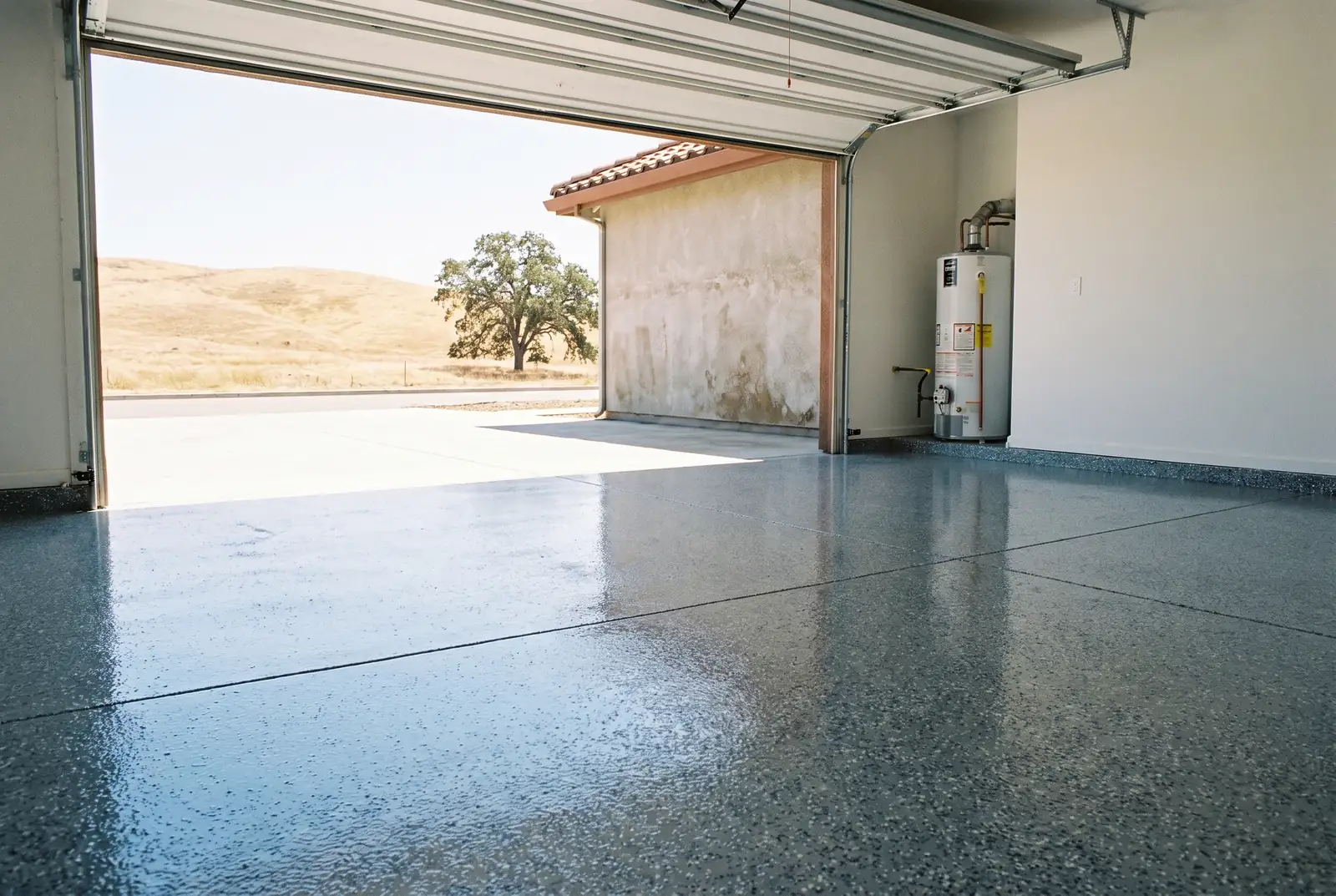
Flake and solid-color systems over a ground slab, sealed with a topcoat that handles hot tires.
Garage floor epoxy details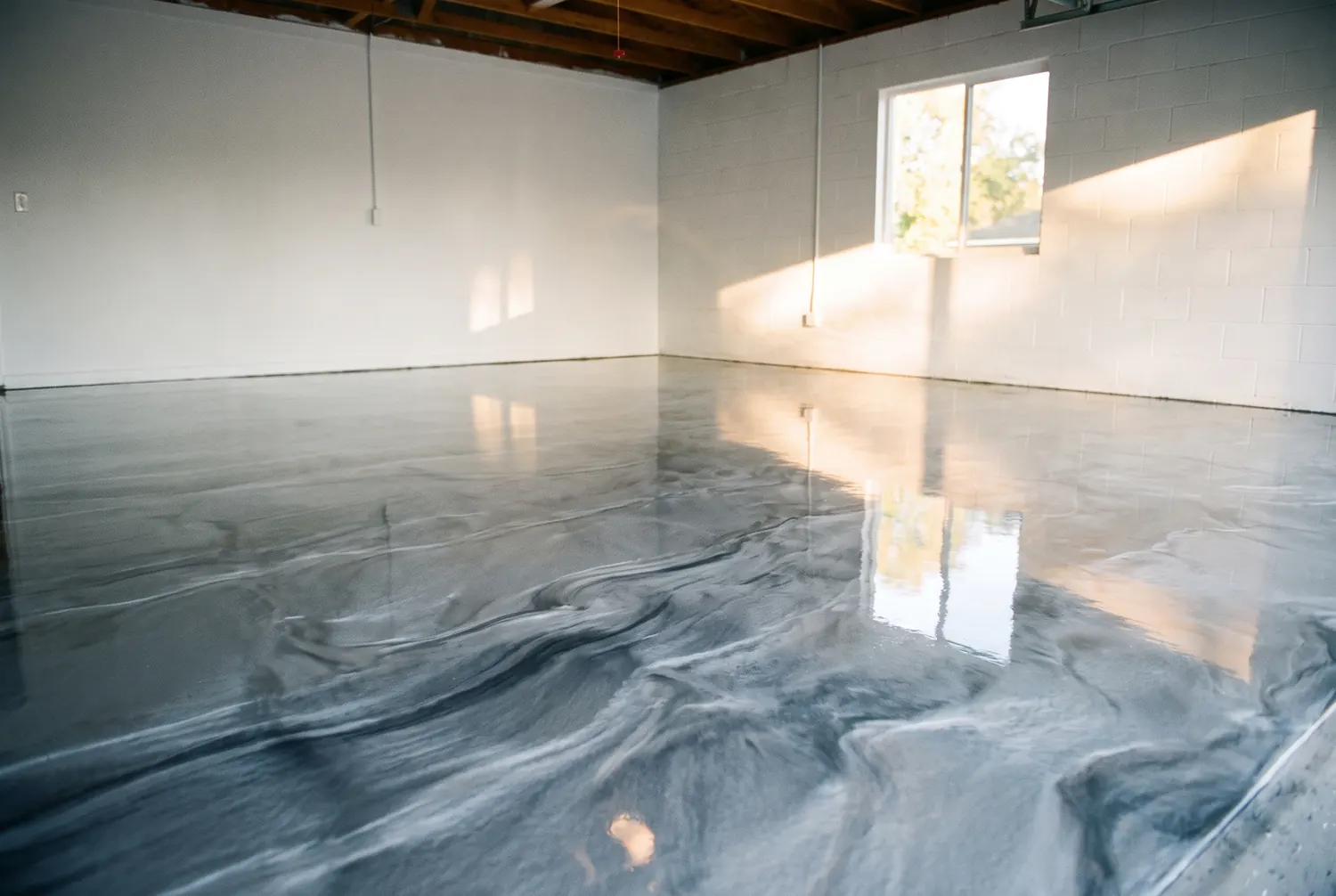
Pigment worked by hand while the resin is wet, so the finished floor has depth and movement.
Metallic epoxy flooring details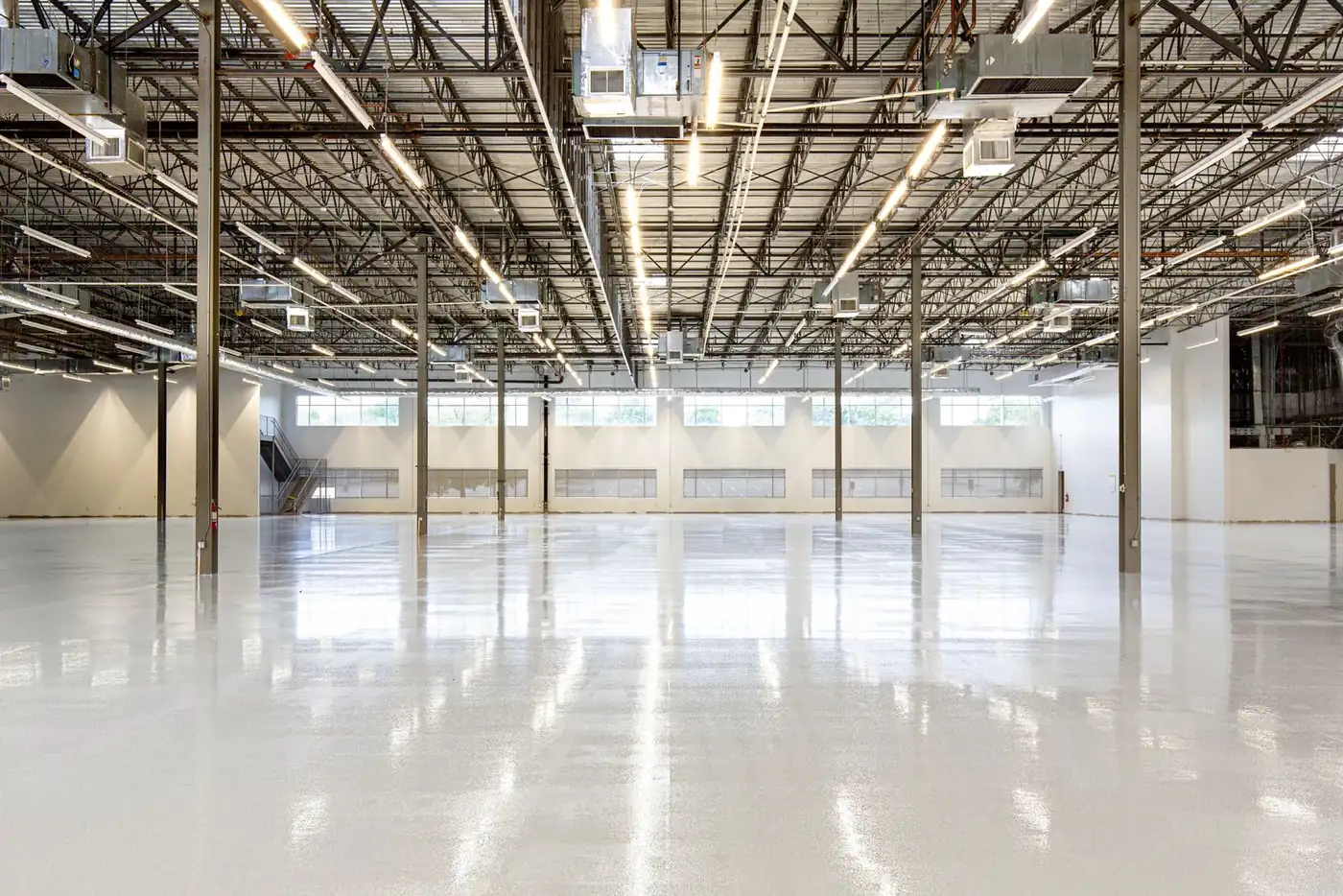
High-build coatings, joint repair and anti-slip aggregate, phased so your operation keeps running.
Commercial epoxy flooring details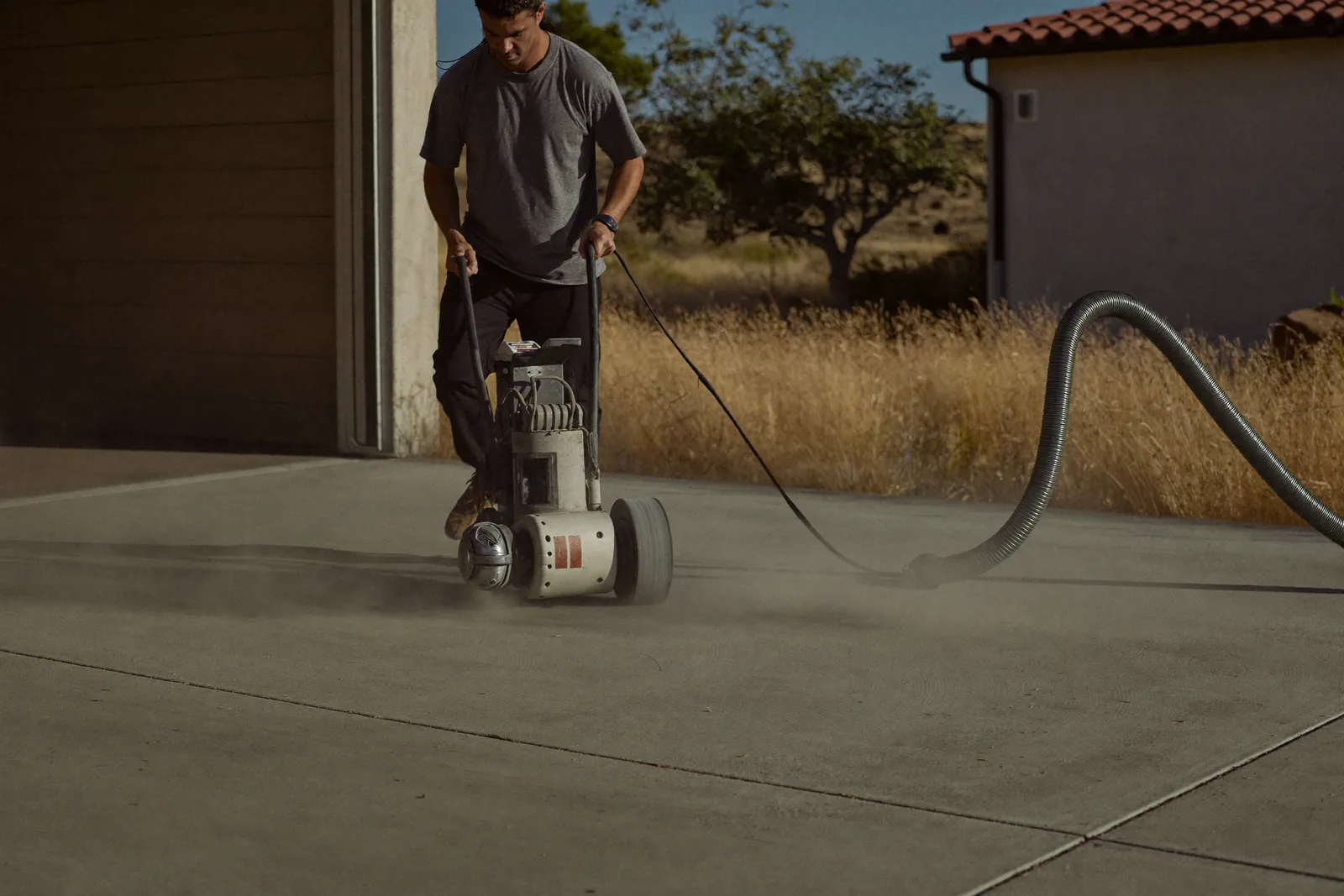
Stripping failed coatings, opening sealed slabs and profiling concrete — also sold on its own.
Concrete grinding detailsFive situations send most homeowners looking for a floor coating.
Sheets lifting near the garage door usually mean the last installer acid-etched instead of grinding. Acid does not remove the silicone and tire polymer soaked into the concrete, so the coating never bonded in the first place.
Hot tire pickup leaves circular dull patches where the car parks. It is a product problem, not a prep problem — low-solids kits soften under a tire that just came off Highway 99 in August.
Bare concrete is porous. Once a slab has drunk enough motor oil, degreaser stops working because the stain lives below the surface. A coating seals the pores so the next drip wipes up.
Gym, workshop, second living space — the floor is the first thing that has to change. Dust from bare concrete never stops, and it settles on everything you store out there.
Central Valley clay moves with the seasons. Hairline cracks get filled with a flexible polyurea before coating; anything wider than a pencil gets evaluated before we quote.
A finished garage floor is one of the quickest ways to make a Brookside or Spanos Park listing photograph better than the one down the street.
A standard two-car garage runs one or two days on site. Here is the actual sequence.
Water dropped on the slab should darken it within a minute. If it beads, the concrete was sealed and needs heavier grinding. On slabs below grade or anything in the older central Stockton neighborhoods, we test for vapor coming up through the concrete — that pressure is what lifts coatings off from underneath.
Walk-behind grinders with vacuum shrouds take off the top layer, including the weak cement paste that machine-troweled slabs leave behind. This is the loud, dusty half of the job and it takes longer than the coating does.
Cracks get chased out and filled, spalled edges get rebuilt, and the patch gets ground flush. Skipping this step means every flaw telegraphs through the finished floor.
The pigmented resin goes down with a squeegee and gets back-rolled. In a garage in July the pot life shortens noticeably above 90 degrees, so we start early and mix smaller batches than we would in winter.
For a flake floor, vinyl chips get thrown into the wet base until the surface is fully covered. The next morning the loose flake gets scraped and vacuumed off.
One or two clear coats seal the flake and carry the wear. This layer decides how the floor handles hot tires and UV.
Walk on it the next day. With a polyaspartic topcoat you can park on it in about 24 hours. With a straight epoxy topcoat, give it closer to a week before the car goes back in, and about a month before the chemistry is fully hardened.
Etching is faster, and it is why so much of the failed coating in this town looks the way it does. Grinding takes more hours per job and it is the single biggest reason a floor lasts.
Stockton gets about 18 inches of rain, and almost none of it falls between mid-May and early October. That dry stretch is why summer installs go smoothly here. It is also why UV stability matters on any floor that catches afternoon sun through an open door — standard epoxy ambers over time, so those floors get a UV-stable topcoat instead.
The person who quotes your floor is on the grinder the morning it happens. Nothing gets handed to a subcontractor between the estimate and the topcoat.
Every floor is quoted after we see it, and the estimate is free. We measure the slab, check it for moisture and cracks, and leave you a written quote before we go — no guessing from a phone call.
| Garage size | Approx. square feet | Typical time on site |
|---|---|---|
| One car | 240–280 | 1 day |
| Two car | 400–576 | 1–2 days |
| Three car | 620–750 | 2 days |
Call (209) 444-2506 and we will come measure the floor, test the slab and walk you through the options. The written estimate is free and there is no obligation.
Not sure which bucket you are in? Call (209) 444-2506 and describe the floor. It is a two-minute conversation.
A proper Garage floor coating and a can of garage paint get lumped together on store shelves, but they behave very differently once a Stockton summer arrives. Afternoon slab temperatures in Weston Ranch or Brookside can climb well past 100 degrees, and the tires on a car that just came off Highway 99 are hotter still. A thin paint film softens under that heat and lifts when the car backs out, which is why so many do-it-yourself garages around town have a bare patch exactly where the tires sit and a clean floor everywhere else.
A professional system is built in layers. We grind the slab with diamond tooling so the base coat can soak into open concrete instead of sitting on top of it, then we test for moisture, because older slabs near the Calaveras River and in the Pacific Avenue neighborhoods often draw dampness up from below in winter. The base coat bonds chemically to the concrete, decorative flake adds texture and hides dust, and a UV-stable topcoat takes the heat, the hot tires and the Delta sun without yellowing.
The result is a floor that handles the things Stockton garages actually see: almond-harvest dust blowing in from the orchards, boat gear dripping after a day on the Delta, and the oil drips that come with keeping an older truck running. Paint hides those stains for a season. A coated floor shrugs them off for years, and a quick mop brings it back to new.
Most of the calls we get in Stockton start with a parking problem and end with a room the family actually uses. Once the slab is sealed and bright, the garage stops feeling like a dusty storage bay and starts working like part of the house. Here is what we see most often around Lincoln Village, Spanos Park and the older neighborhoods off March Lane.
Home gyms top the list. A garage floor coating gives rubber mats and racks a flat, sealed base that will not shed concrete dust onto equipment, and it wipes clean after a sweaty workout. Workshops are a close second. Sawdust and metal shavings sweep up in one pass instead of settling into pores, and dropped tools do not chip the surface the way they chip bare concrete.
Delta families use the space for boat and fishing gear. River water, bait and gas drips come off with a hose, and the topcoat keeps the smell from soaking into the slab. Gardeners and backyard growers like the same thing for potting soil and fertilizer. And a lot of homeowners simply want a garage that matches the rest of a house they take care of, especially before listing it, when a glossy floor is the first thing a buyer notices at the walk-through.
Whatever the plan, tell us when we come out to measure. A gym floor, a shop floor and a show floor each call for a slightly different texture and topcoat, and picking the right one up front is what makes the space work for the next decade.
We measure the slab, check it for moisture, and give you a written number before we leave. No charge and no obligation.
A properly ground and coated garage floor typically holds up 10 to 20 years under normal residential use. The two things that shorten that are skipped surface prep and a thin topcoat that cannot handle hot tires in a Central Valley summer.
It depends on the size of the floor, how much concrete repair it needs, whether an old coating has to be stripped, and the finish you pick. We measure and test the slab at a free on-site estimate and give you a written quote before anything is scheduled.
Yes, and summer is actually the easiest season here because Stockton goes essentially rainless from mid-May to early October. The adjustment is timing: above about 90 degrees the resin's working time shortens, so we start early in the day and mix in smaller batches.
Almost always one of two reasons. Either the concrete was acid-etched instead of diamond-ground, which leaves tire polymer and silicone in the slab so the coating never bonded, or moisture vapor moving up through the slab built enough pressure underneath to push the coating off.
Epoxy is the base layer and builds thickness and adhesion, but it cures slowly and can yellow with UV exposure. Polyaspartic is dry to walk on in about an hour, holds its color in sunlight, and goes down across a wider temperature range. Most floors we install use epoxy as the base with a polyaspartic clear coat on top.
Yes, the slab needs to be completely clear before grinding starts. Emptying it yourself the night before keeps the crew on the floor instead of on your storage, and it helps the job finish on schedule.
340 N California St Unit 2, Stockton, CA 95202
Please note: This is our service business address — not a storefront or showroom. Stockton Epoxy Floors is a mobile epoxy flooring service, so we come to you and the office isn’t open to walk-in visitors. Call us and we’ll set up a free on-site estimate.